
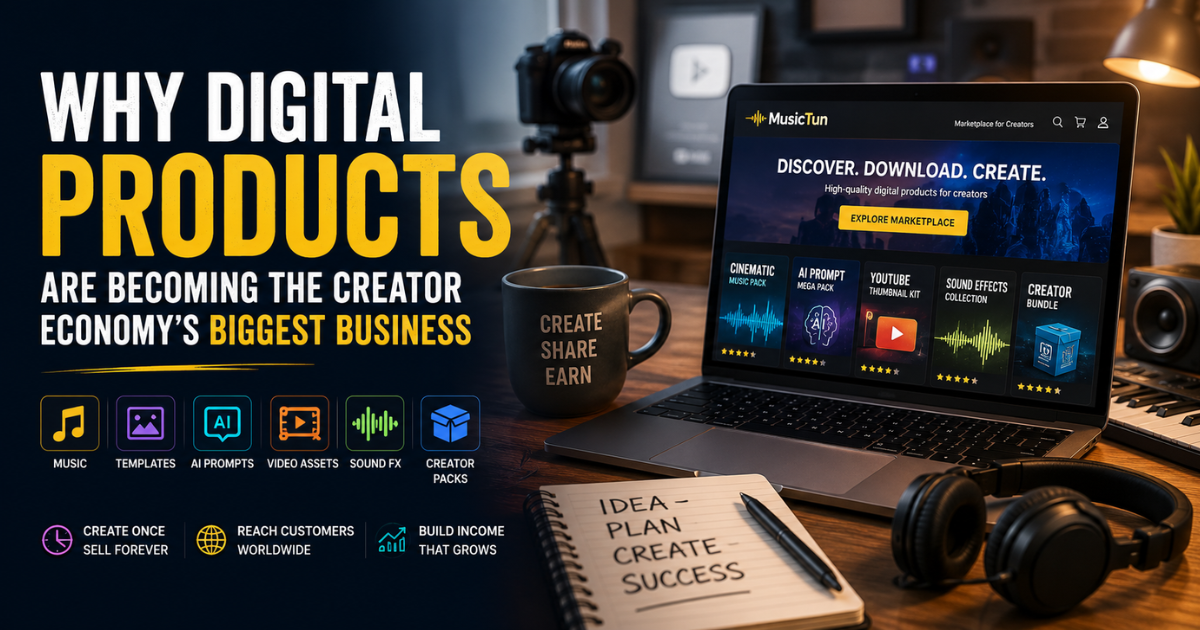
A decade ago, most creators earned money through advertising, sponsorships, or freelance work. Today, a quiet revolution is taking place. Instead of relying solely on clients or algorithms, more creators are building businesses around something they create once and can sell thousands of times: digital products.
From AI prompt packs and royalty-free music to templates, graphics, sound effects, and complete Creator Packs, digital downloads have become one of the most valuable assets in the modern creator economy. They require no warehouse, no shipping, and no physical inventory—yet they can reach customers anywhere in the world within seconds.
For many creators, this shift has transformed side projects into sustainable businesses.
The Rise of the Digital Creator Economy
The internet has dramatically lowered the barrier to starting a business. Anyone with a computer and an idea can publish videos, write articles, compose music, design graphics, or create educational content.
But while creating content has become easier, standing out has become much harder.
Millions of videos are uploaded every day, countless blog posts compete for attention, and social media rewards creators who publish consistently. That pressure has led many creators to rethink how they spend their time.
Rather than creating everything from scratch for every project, they invest in reusable assets—or create those assets themselves and sell them to others.
This has fueled explosive growth in the digital products market.
What Exactly Is a Digital Product?
A digital product is any item that can be downloaded or accessed electronically after purchase. Unlike physical goods, digital products can be sold repeatedly without additional manufacturing or shipping costs.
Popular examples include:
- Royalty-free music libraries
- AI prompt collections
- Video editing templates
- Graphic design assets
- Sound effect bundles
- Printable planners
- Educational guides
- Lightroom presets
- 3D models
- Creator Packs
- Stock photos
- Digital artwork
Once created, these products can continue generating income for months or even years with relatively little ongoing maintenance.
Why Creators Are Choosing Digital Products
For many creators, time is their most limited resource.
Producing videos, writing articles, editing podcasts, managing social media, and responding to an audience can quickly fill an entire week. Adding client work on top of that often leaves little room to build something that generates long-term value.
Digital products offer a different path.
Instead of trading hours for money, creators invest their time upfront to develop resources that can be downloaded again and again. While success is never guaranteed, the model offers a level of scalability that traditional freelance work often cannot match.
This approach also allows creators to diversify their income. Advertising revenue can fluctuate, sponsorship opportunities may come and go, but a well-crafted digital product can continue selling independently of platform algorithms.
The AI Boom Has Changed Everything
Artificial intelligence has accelerated demand for digital products in ways few expected.
As creators adopt AI tools for writing, image generation, video production, and music composition, they're discovering that the quality of the output often depends on the quality of the input.
That's why products such as prompt libraries, workflow templates, style guides, and curated Creator Packs have become increasingly valuable. They help users move past the blank page and achieve better results more quickly.
Rather than replacing creativity, these resources give creators a stronger starting point.
Small Products Can Create Big Value
One of the biggest misconceptions about digital products is that they need to be massive to succeed.
In reality, many successful products solve a single problem exceptionally well.
A collection of cinematic sound effects may help video editors improve their productions. A pack of SEO-optimized article templates might save bloggers several hours each week. A library of fantasy-themed AI prompts could inspire game designers and digital artists.
Customers rarely buy digital products because they want more files. They buy them because they want to save time, improve quality, or learn a new skill.
The most successful products focus on delivering exactly that.
Why Marketplaces Matter
As the number of digital products grows, finding high-quality resources has become more difficult.
Creators often spend hours searching multiple websites for music, graphics, prompts, templates, and other production assets. A dedicated marketplace simplifies that process by bringing different types of resources together in one place.
Instead of jumping between several platforms, creators can browse collections organized by category, creative field, or project type. Whether someone is producing a YouTube video, designing a game, launching a podcast, or writing a blog, having access to a well-organized marketplace can significantly streamline the creative process.
Marketplaces also benefit sellers. Rather than building their own e-commerce systems from scratch, creators can focus on developing high-quality products while reaching customers who are already looking for creative resources.
The Opportunity for Independent Creators
The demand for digital assets continues to grow as more people launch YouTube channels, podcasts, online businesses, newsletters, and social media brands.
This creates opportunities not only for content creators but also for musicians, designers, writers, developers, educators, and artists.
A composer can package cinematic background tracks. A designer can create icon collections or templates. A writer can publish prompt packs or educational guides. Even specialized knowledge can become a valuable digital product when presented in a practical format.
The creator economy is no longer limited to influencers with millions of followers. Increasingly, success comes from serving specific audiences with useful, high-quality resources.
Quality Will Always Win
As AI makes it easier to generate content, the internet is becoming flooded with low-effort digital products.
That makes quality more important than ever.
The products that stand out are thoughtfully organized, professionally presented, and genuinely useful. They solve real problems instead of simply adding more files to someone's hard drive.
Creators are becoming more selective, choosing resources that improve their workflow rather than overwhelming it.
For sellers, this is encouraging news. It means expertise, originality, and attention to detail remain valuable advantages.
Looking Ahead
The creator economy shows no signs of slowing down. If anything, the demand for high-quality digital resources is likely to increase as more individuals and businesses embrace online content creation.
Whether you're producing videos, composing music, designing graphics, writing articles, or building AI-powered workflows, digital products offer a way to create value that extends beyond a single project.
For buyers, they provide tools that save time and spark creativity. For sellers, they represent an opportunity to build scalable income around knowledge and creative skills.
As dedicated marketplaces continue to grow, discovering, buying, and selling digital products will become an increasingly important part of the creative ecosystem.
For creators looking to work smarter instead of harder, the future is likely to be digital.
Discover Digital Products on MusicTun
Whether you're searching for Creator Packs, royalty-free music, AI prompt collections, sound effects, graphics, templates, or other creative assets, MusicTun brings together digital resources designed to help creators produce more in less time.
Explore the marketplace, discover new tools for your workflow, and find resources created by people who understand the challenges of modern content creation.
Comments (0)